
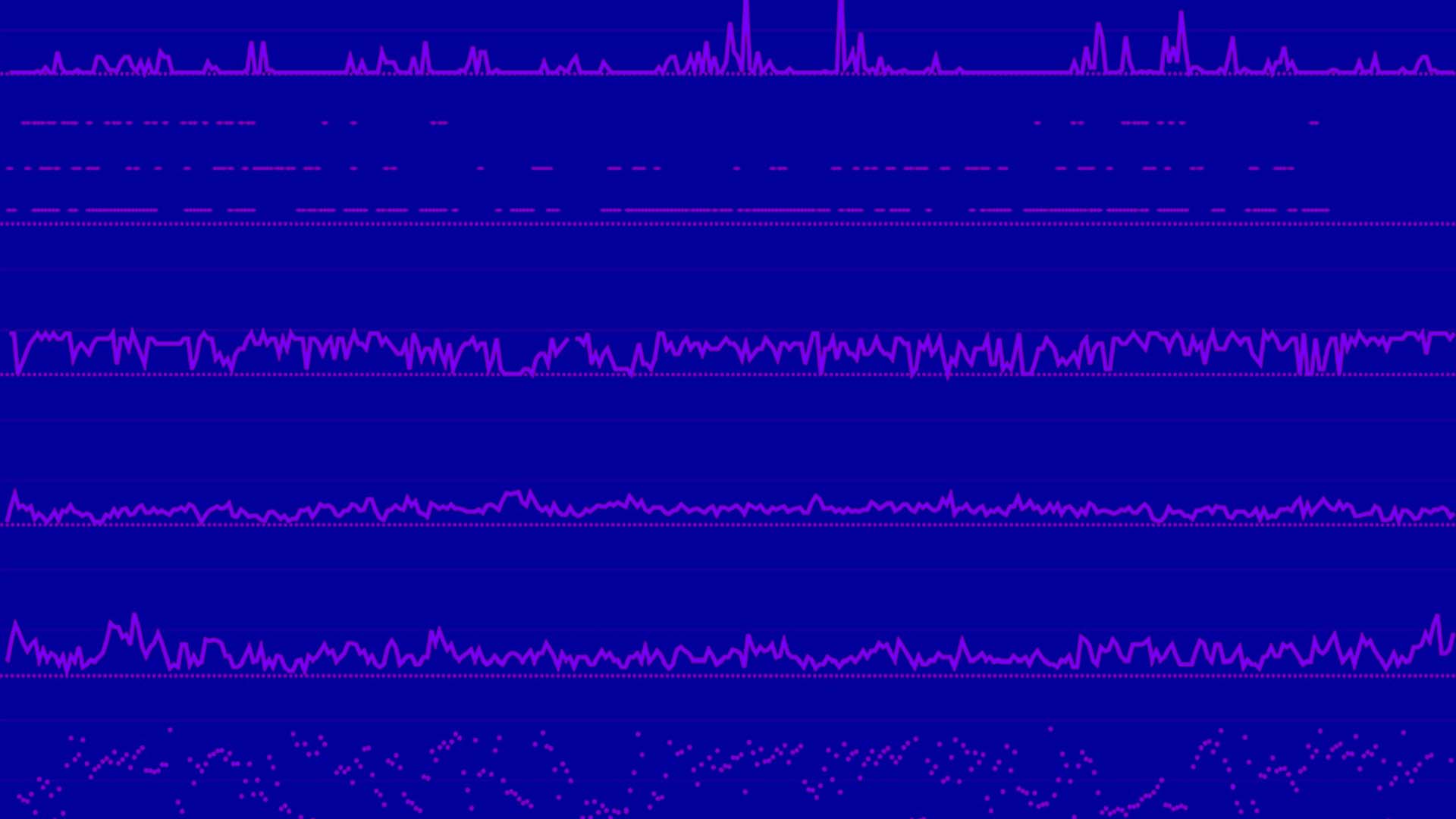
Data does not arrive with a sound attached to it. A dataset becomes musical only through decisions: which relationships matter, how they should be mapped and what listeners need in order to understand the result.
That is where the poetry begins. Sonification can preserve information while opening another way to experience change, scale and repetition. It does not replace a chart or an explanation. It gives data a temporal and physical form that can be heard in a room.
FROM VALUES TO MUSICAL RELATIONSHIPS
A rising value might lift a pitch. Repeated events might create a rhythm. Several processes might change harmony, density or spatial movement at the same time. These mappings can be direct, but they are never neutral.
The composer chooses what to emphasise and what to leave out. A technically exact mapping may still be impossible to hear, while a more selective translation can make one important relationship clear. The task is to keep the connection to the source data legible without asking the data to carry a meaning it cannot support.
This makes sonification both analytical and compositional. It begins with a perceptual question: what should the audience be able to notice?
PROJECTS IN PRACTICE
One of our early data-driven works was created for Fjord & Bælt, a marine research centre in Kerteminde, Denmark. Weather measurements and underwater recordings from the area became material for a four-hour multichannel soundscape in the centre's underwater tunnel.
The composition compresses longer environmental cycles into a duration visitors can experience. A day passes in forty seconds; a month lasts twenty minutes. Changes in the data influence the density, texture and development of the music.
The work does not attempt to explain every measurement. It creates a long-duration environment connected to the conditions around the research station. Data, field recordings and composition each retain a distinct role while contributing to one spatial experience.
Chasing Waterfalls
CHASING WATERFALLS approached computation from another direction. The music-theatre production at the Semperoper Dresden used artificial intelligence to generate text and musical material alongside human performers.
The system was not presented as an invisible production tool. Its uncertainty became part of the work. Machine-generated phrases raised questions about authorship, selection and control, while the human performers gave those outputs context on stage.
This changed where compositional decisions were made. They appeared in the training material, the rules, the selection of results and the response to unexpected output. The artistic work lay in designing the system and interpreting what it produced.
INFORMATION AND INTERPRETATION
Data-driven music can create a strong emotional response. That response should not be confused with evidence.
A sonification needs enough context for listeners to understand what has been translated. The source, scale and limitations of the data matter. So does the distinction between a measured relationship and a musical interpretation.
This is especially important when a work addresses climate, migration, public language or another complex subject. Sound can make change perceptible, but it should not imply more certainty than the underlying data provides.
Clear framing gives the composition a stronger foundation. Once the audience understands the relationship, variation, ambiguity and emotion can develop without obscuring the source.
The same need for context applies when sonification unfolds across architecture. Different datasets may belong to different zones; a changing value may move through a loudspeaker field; live input may alter a generative composition over time.
Sound scenography places these behaviours within the wider visitor journey. A spatial score coordinates when data-driven layers appear and what they may overlap with. Generative sound allows the work to continue without exact repetition. Interactive sound lets visitors influence the system where their action has a meaningful connection to the subject.
The result can be informative, atmospheric or openly musical. What matters is that the translation remains intentional and perceptible.
These principles guide our work in data sonification, generative sound and spatial installations, where complex information becomes a clear listening experience.
