
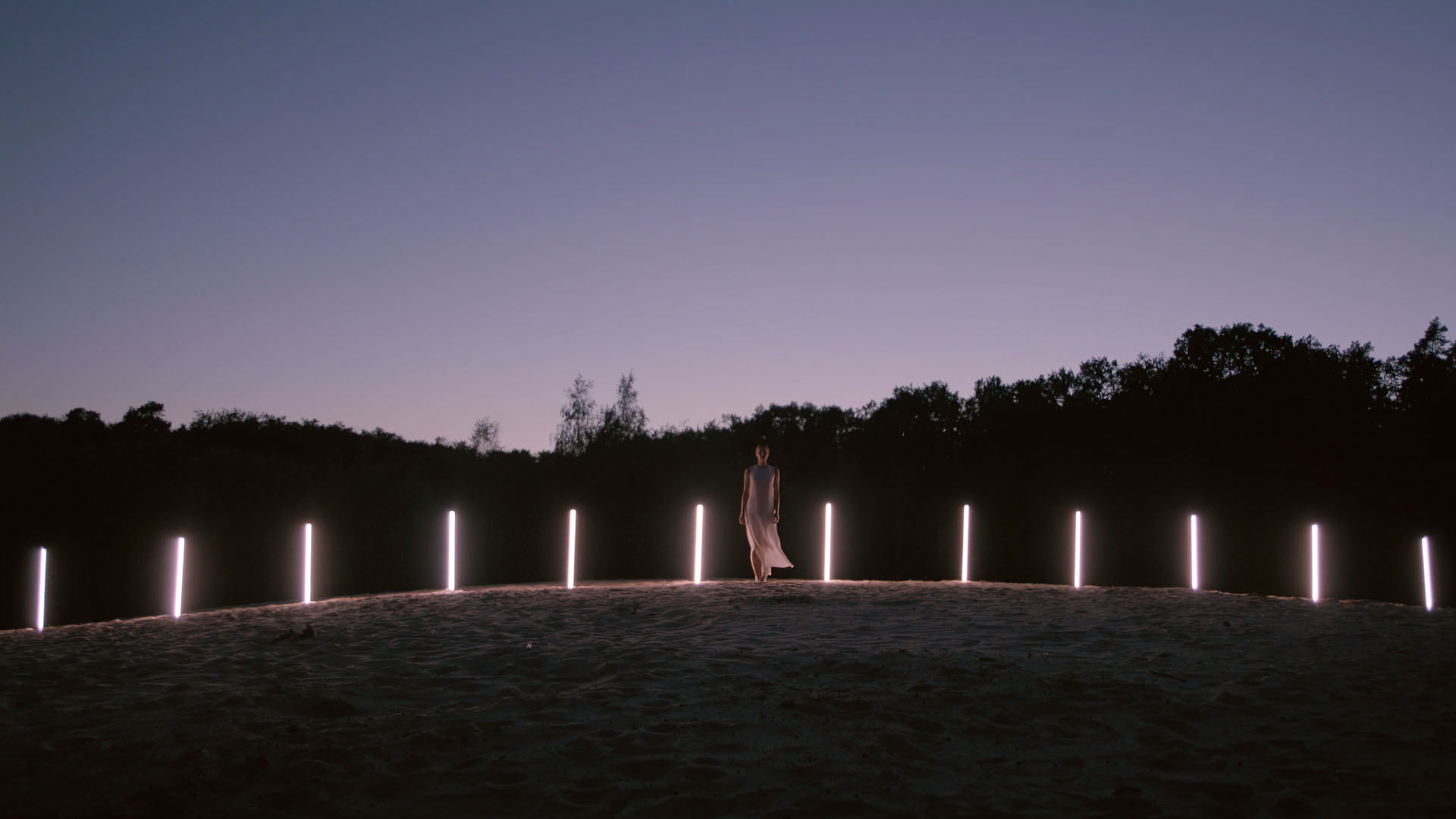
Sound scenography is the design of how sound behaves in space.
It connects composition, spatial audio, dramaturgy and architecture into one spatial and temporal structure. Instead of treating sound as a media layer added to an environment, it considers sound as part of how the environment is perceived, navigated and remembered.
In exhibitions, museums, pavilions and installations, this approach shapes how visitors orient themselves, move through content and feel a space unfold over time.
The term brings two ideas together: sound and scenography.
Scenography describes the design of an experience in space: how architecture, objects, light, media, movement and timing form a coherent situation. Sound scenography adds listening to this structure. It asks where sound should appear, how it should move, when it should withdraw, and how it should relate to bodies, rooms, objects and transitions.
In this sense, sound can guide without instructing. It can connect separate moments into one narrative. It can create intimacy, tension, orientation or collective presence. The result is not only something visitors hear. It becomes part of how they understand the space.
This effect becomes clearer when we look at what sound contributes to a space. It establishes atmosphere before listeners consciously interpret it, making a place feel open, dense, intimate, unstable, calm or alive.
It also gives the visitor journey a temporal structure. Sound can build expectation, mark a transition or direct attention towards a particular object or route. When it connects research, memory or narrative to a place, meaning becomes perceptible through the body as well as through explanation.
Sound scenography usually begins before individual sounds are composed.
The first question is not "what should it sound like?" but "what role should listening play in this space?"
From there, the work can include:
Sonic dramaturgy
Defining how sound develops across the visitor journey: where it begins, where it changes, where it creates focus and where it leaves room for silence.
Spatial composition
Composing for rooms, routes, perspectives and listening positions rather than for a fixed stereo image.
Acoustic relationships
Considering materials, distances, reflections, masking and the coexistence of multiple sound sources.
System behaviour
Defining how sound is distributed, localized, layered, triggered, generated or changed by interaction.
On-site tuning
Refining the work in the actual space, where composition, architecture and visitor movement finally meet.
Exhibitions and museums often need sound to do several things at once.
It may support orientation, create atmosphere, separate media zones, connect rooms, intensify objects, or help visitors feel the scale of a subject. A careful scenographic structure prevents sound from becoming noise. It allows multiple installations, voices and media layers to coexist inside one spatial experience. This is especially important in cultural spaces, where visitors move freely, attention shifts constantly and sound has to support content without overpowering it.
For a broader reflection on the role of sound in immersive design, see our essay on sound as a central layer of spatial experience.
In exhibitions, this wider scenographic structure is carried by several more specific practices. Spatial audio determines how sound is positioned and moved around listeners, while immersive sound concentrates on presence and bodily perception.
Exhibition sound design applies those decisions to museums, pavilions and visitor routes. Interactive sound adds responsive behaviour, allowing movement, sensors or live systems to change what is heard. Sound scenography holds these practices together within one spatial and dramaturgical idea.
These KLING KLANG KLONG projects show how sound scenography can take different forms: as a museum route, pavilion journey, research installation or immersive spatial composition.
A 1.7-kilometre museum route becomes one continuous sonic narrative. Each room offers a different acoustic perspective on the same event, turning architecture into a sequence of listening positions.
Luxembourg Pavilion - Expo 2020 Dubai
A layered spatial composition accompanies the visitor journey along the pavilion's continuous path. Distinct musical chapters remain legible while blending into one coherent sonic experience across the building.
Humboldt Forum Berlin - Research Wall
Different research voices receive their own sonic identity while remaining part of one spatial composition. Sound helps visitors navigate complexity without flattening it.
An immersive sound environment translates complex relationships into spatial experience. Sound unfolds as a living structure, making interconnection perceptible through movement and listening.
Sound becomes part of the pavilion's spatial identity, connecting architecture, dramaturgy and visitor movement into a shared experience.
Interactive sound and spatial composition support a playful, participatory environment where visitors become part of the sonic system.
Sound scenography is not only a conceptual discipline. Its spatial ideas also depend on systems, renderers and production workflows that can carry them into architecture.
Spatial Audio Systems & Renderers
Spatial Audio Production Workflows
These technical notes sit alongside three broader perspectives on the practice. The Role of Sound in Immersive Design examines attention and presence, Acoustic Blueprinting explains how listening enters architectural and curatorial planning, and Sonic Dramaturgy follows sound through the visitor journey.
What is sound scenography?
Sound scenography is the design of how sound behaves in space. It connects composition, spatial audio, dramaturgy and architecture into one spatial and temporal structure.
How is sound scenography different from sound design?
Sound design often describes the creation of specific sounds or audio content. Sound scenography describes how sound structures an experience across space, time, movement and narrative.
Where is sound scenography used?
It is used in exhibitions, museums, pavilions, installations, public spaces and spatial experiences where sound is part of how visitors perceive and navigate the environment.
When should sound scenography begin in a project?
It should begin early, together with architecture, exhibition design, media planning and narrative development. This allows sound to become part of the spatial concept rather than an added layer.
How does sound scenography relate to spatial audio?
Spatial audio is one of the techniques used to position, move and distribute sound. Sound scenography is the wider concept: it defines why, where and how sound should behave within the experience.
Planning an exhibition, museum or spatial experience?
We design sound scenography that shapes orientation, atmosphere and the way visitors move through space.
