
Spatial audio describes how sound is distributed, localized and experienced within a space.
It shapes how visitors perceive distance, direction, scale and movement. In exhibitions, installations and spatial experiences, sound does not only play from loudspeakers. It becomes part of the architecture, the visitor route and the way a space unfolds over time.
In practice, this means designing how sound behaves in relation to architecture, loudspeaker placement, acoustic conditions and listener position.
It extends beyond stereo or surround formats. Spatial audio can include multichannel systems, localized sound sources, acoustic zoning, object-based sound, directional speakers, distributed loudspeakers and carefully tuned transitions between areas.
The goal is not technical complexity for its own sake. The goal is to make sound spatially meaningful: close or distant, focused or atmospheric, directional or surrounding, fixed or moving.
Spatial sound can define how a space is read.
Through composition, loudspeaker strategy and on-site tuning, sound can mark thresholds, connect separate areas, create focus within open environments or give a room a distinct acoustic identity. When these behaviours need to be coordinated across rooms, media and visitor movement, a spatial score gives all disciplines involved a shared view of the listening structure.
This shifts sound from a media layer to a spatial layer. Visitors do not simply hear it. They move through it.
Exhibitions and museums
In exhibitions and museums, sound can connect exhibits into one coherent visitor journey. It supports orientation, reinforces content and structures routes through acoustic transitions, localized sound and spatial contrast.
Installations and immersive environments
Spatial sound can become the body of an installation. It can surround visitors, respond to their position or create a composition that changes as they move.
Architecture and public space
Sound can define atmosphere, scale and proximity. It can create intimacy within large environments or articulate different zones within an open layout.
Performances and staged experiences
For performances and staged experiences, musical material can be placed around performers and audiences, creating depth, movement and perspective beyond a frontal stage image.
Planning Spatial Audio
Spatial audio needs to be planned from the role sound should play in the experience. Before choosing a format, system or loudspeaker layout, the first question is what spatial behaviour is needed: should sound guide orientation, create atmosphere, connect rooms, support interaction, give content physical presence or make movement through the space more legible?
From there, composition and technical planning develop together. Loudspeaker strategy, acoustic zones, content structure and visitor movement all affect each other. A sound may need to remain local, travel between areas, appear from a precise point, surround the body or change as visitors move through the space.
This is why spatial audio should not be treated as a late playback decision. It becomes clear only when the spatial idea, the architecture and the playback system support the same experience.
This spatial approach is one foundation of our broader practice of sound scenography.
While spatial audio focuses on how sound behaves in space, sound scenography connects this behaviour with narrative, dramaturgy, interaction and the emotional arc of the visitor journey.
Learn more about sound scenography.
An orchestral score unfolds across four floors of the pavilion. Visitors move through distributed musical layers, experiencing composition as a spatial journey through the building.
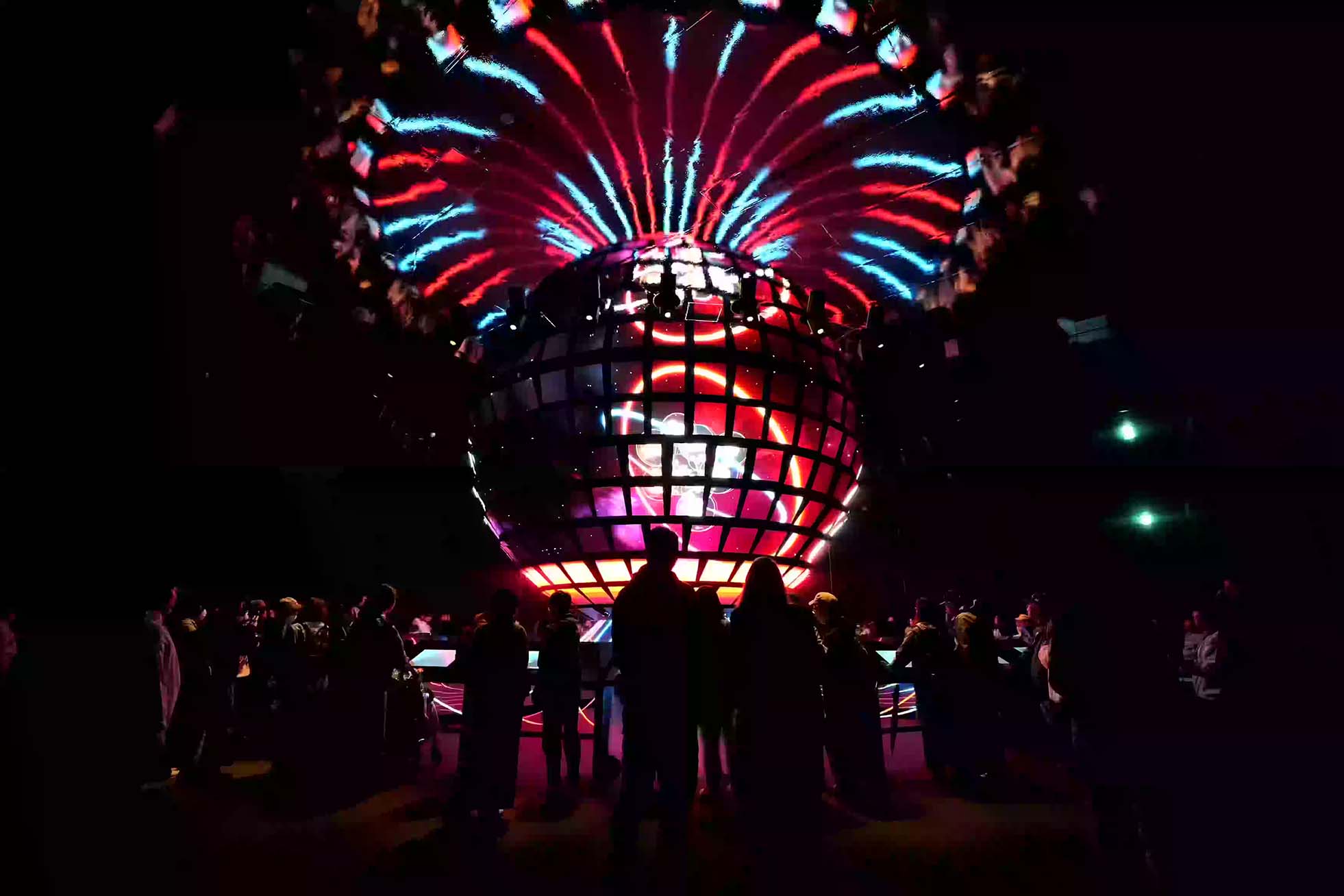
A responsive sound and light environment surrounds the body with evolving sonic states. Ceiling speakers, exciters and low-frequency elements create a spatial field that shifts between passive, reactive and interactive modes.
A walk-in 3D sound installation in which 24 loudspeakers form the spatial body of an artificial entity. Visitors generate and manipulate sounds from a central stage while the soundscape unfolds around them.
A sonic journey through the universe
At TED2024, spatial sound, field recordings and data-driven music guided the audience from Earth toward cosmic scale. The performance was experienced entirely through sound in a surround environment.
An immersive exhibition where spatial sound and haptic feedback form a musical ecosystem. Visitors encounter animal migration and connected ecosystems through movement, listening and vibration.
For a more detailed look at the technical layers behind spatial audio, these notes explain how systems, formats and production workflows shape what can be heard in the final space.
Spatial Audio Systems & Renderers
Spatial Audio Formats & Methods
Spatial Audio Production Workflows
What is spatial audio?
It describes how sound is distributed, localized and perceived in space. It considers loudspeaker placement, acoustic conditions, architecture and listener position.
Is spatial audio the same as surround sound?
No. Surround sound is one format. Spatial audio is a broader approach to how sound behaves in relation to architecture, movement and perception.
How is spatial audio used in exhibitions and installations?
It can create depth, direction, proximity, transitions and acoustic zones. It helps visitors experience sound as part of the space rather than as a fixed playback source.
Does spatial audio always require many loudspeakers?
No. The number of loudspeakers depends on the spatial intention. A precise system can be simple or complex depending on the room, content and visitor journey.
When should spatial audio be planned?
Spatial audio should be considered early, together with architecture, exhibition design, media planning and visitor flow. This makes it possible to design sound as part of the spatial concept rather than as a late technical layer.
Planning a spatial sound system for an exhibition, installation or immersive environment?
We design spatial audio in relation to architecture, content and visitor movement.
