
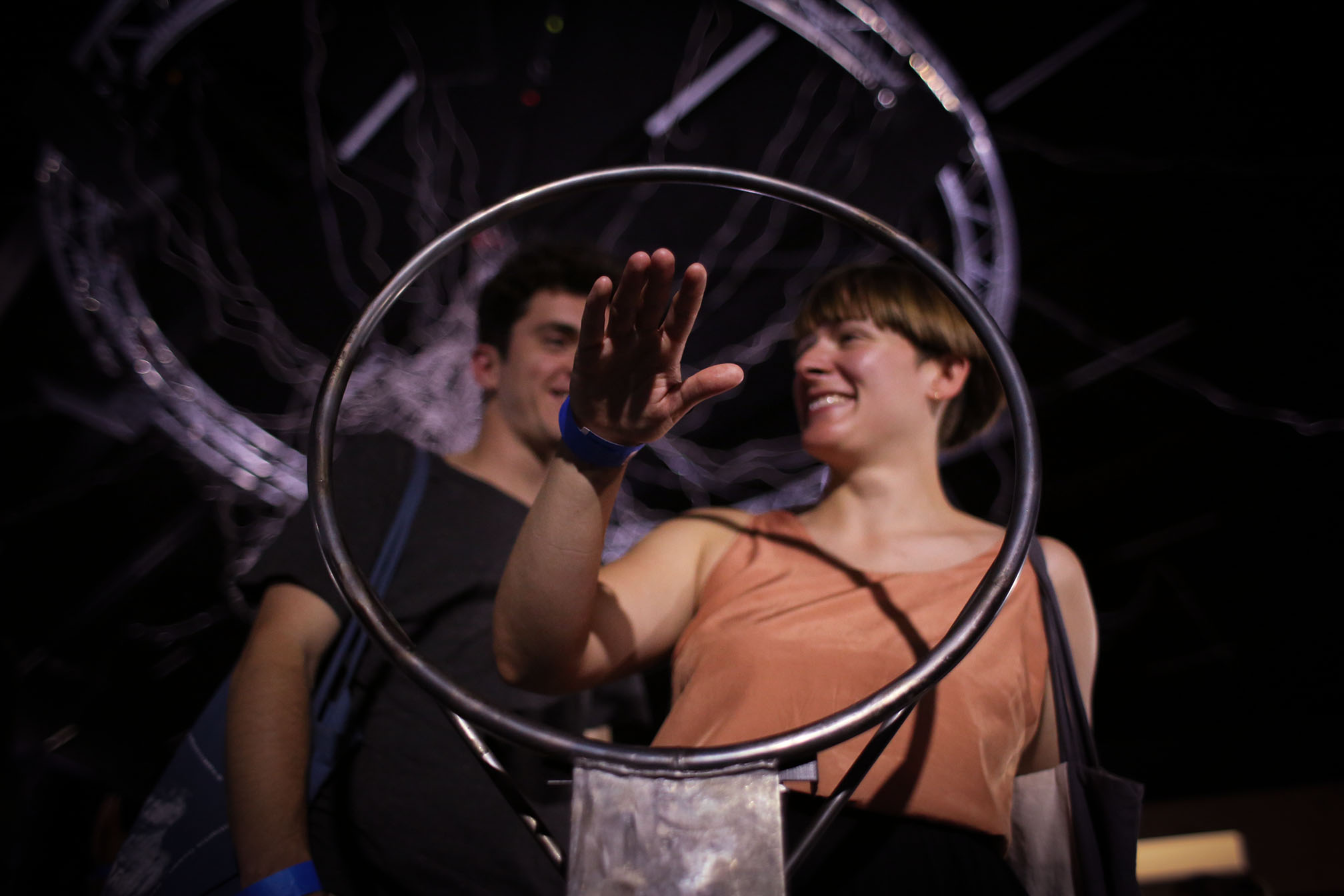
Interactive sound responds to what happens in a space. Movement, presence, touch, gesture, data or visitor behaviour can change what is heard, giving actions an audible consequence.
In exhibitions, installations and cultural spaces, this response makes invisible systems perceptible and lets visitors hear that the space has noticed them.
Interactive sound describes systems that respond to input from sensors, cameras, tracking systems, touch interfaces, physical objects, environmental data or the movement of visitors through space.
These inputs can trigger, transform, spatialise, generate or recompose sound in real time. The technology provides the mechanism, but the design begins with the experience it should create. A response may confirm an action, guide exploration, introduce surprise or give movement a sense of weight and texture.
When the relationship between action and response is clear, visitors can understand the space, the content and their own role within the system through listening.
Interactive sound can give movement a sense of texture, weight or resistance. A gesture may feel soft, sharp, heavy, elastic or fragile depending on the timing, dynamics, frequency and spatial behaviour of the response.
This is particularly useful in exhibitions and installations where visitors interact with systems they cannot see. A well-timed sound confirms that an object, gesture or movement has been recognised and makes the consequence of that action perceptible.
Feedback can also invite someone to move closer, slow down, repeat an action or explore another part of the space. When the relationship remains discoverable, visitors can become performers or collaborators without having every possibility explained in advance.
Interactive sound brings concept, composition, spatial design and system behaviour into one process. The work begins by defining what visitors can do, what the response should communicate and how their movement, proximity, touch, data or presence will be detected. Sonic Architects examines this use of code as a creative layer in responsive environments.
The next step is to develop the rules that connect those inputs to sound. The material must be flexible enough to change without becoming repetitive or chaotic, and its position in the room should connect the response to the body, object or area where the interaction occurs.
Testing concentrates on timing, sensitivity, volume and behaviour in the real space. A technically correct trigger can still feel late, exaggerated or detached from the action. Its musical character and spatial position determine whether the interaction feels playful, intimate, forceful or fragile.
Sound scenography then places each interaction within the wider experience. It considers where visitors encounter the system, how they discover its rules and how its behaviour develops over time. This connects interactive sound to the listening expectations described in How Games Trained Us to Listen, where sound acts as feedback, orientation and behaviour as well as atmosphere.
Spatial audio, immersive sound, exhibition sound design and generative sound can all support this structure. Their role is to make the interaction belong to the place instead of feeling like an isolated effect.
Examples of interactive sound in our work include:
Musical direction and sound design guide visitors from listening to participation, supporting a pavilion experience in which audiences take part in the sound.
Visitors generate and manipulate sounds on a central walk-in stage. Through 24 loudspeakers, interaction becomes part of a spatial sound installation where control shifts between human gesture and autonomous behaviour.
A responsive sound and light environment surrounds the body with changing sonic states. More than 80 soundscapes shift between passive, reactive and interactive modes.
A spatial sound environment forms a musical ecosystem across Water, Air and Land. Sonic and haptic feedback support interaction, making ecological relationships perceptible through listening, movement and vibration.
An interactive installation about personal data, capture and deletion. Sound follows printing, shredding and the illusion of control, making digital processes physically perceptible.
For the broader spatial practice behind interactive sound, see Sound Scenography.
For immersive environments and visitor perception, read The Role of Sound in Immersive Design.
That conceptual framework also depends on spatial systems and production workflows that can test movement, response and playback conditions together. Spatial Audio Systems and Renderers and Spatial Audio Production Workflows describe this technical layer.
What is interactive sound?
Interactive sound is sound that responds to input such as movement, touch, proximity, sensors, data or visitor behaviour. It changes in real time instead of playing back as fixed audio.
How is interactive sound used in exhibitions?
It can provide feedback, guide exploration, support participation, make invisible systems perceptible and help visitors understand content through action.
Can interactive sound feel physical?
Yes. Sound can give movement a sense of texture, weight, resistance or impact through timing, rhythm, dynamics, frequency and spatial behaviour. This can create a form of tactile or haptic sensation, even without physical vibration.
What is the difference between interactive and generative sound?
Interactive sound responds to input such as movement or visitor action. Generative sound creates variation through rules or systems, often without direct user input. In many installations, both approaches are combined.
What technologies are used for interactive sound?
Interactive sound systems can use sensors, cameras, tracking systems, touch interfaces, real-time audio processing, spatial audio systems and custom software.
Planning an interactive installation or responsive environment?
We design sound systems that make movement, presence and behaviour feel alive.
