A spatial score is a dramaturgical timeline matrix for sound in space.
It defines when sonic elements appear, where they appear, how they behave over time and how they relate across rooms, media, architecture and visitor movement. It gives structure to music, voices, sound effects, ambiences, interface sounds, film scores, generative systems, interactive events, physical soundscapes and silence.
Within Sound Scenography, the spatial score gives the sonic world of a space its temporal and spatial form. It organizes how sounds appear, relate, travel, repeat, transition and support the dramaturgy of the whole experience.
Like a musical score, it works through time. A musical score is the composition in musical form. A spatial score works at the scale of the spatial experience and places musical and non-musical sound inside one larger architectural dramaturgy.
It composes time across space.
Sound is a time-based medium. To orchestrate sonic assets across rooms, exhibits, media systems and visitor routes, we need to know when something happens. Every sonic element has temporal behaviour: a beginning, a duration, a recurrence, a density, a transformation, an interruption, a decay.
This applies to a composed piece of music as much as to an ambience, a loop, a triggered interface sound, a voice, a physical sound source or a generative system. Even a seemingly stable atmosphere develops through time. It repeats, shifts, accumulates, withdraws or changes its meaning through relation to other sounds.
The spatial score makes these relationships composable. It gives every sonic element a place within the whole: where it enters perception, how long it remains, what it overlaps with, what it prepares, what it answers and how it contributes to the overall dramaturgy of the experience.
The result is a shared structure for composition, sound design, spatial audio, media planning, scenography, architecture and technical systems. Everyone can see how sound behaves across the entire experience.
To call the spatial score a script is useful because it defines the dramaturgical structure of the sonic experience before individual sound assets are produced in detail. It describes what appears, where it appears, when it enters perception, how it relates to other sonic layers and how it supports the larger arc of the space.
This script is written across architecture. It connects compositions, sound design, ambiences, voices, media systems, generative behaviours, interactions, acoustic zones and silences into one spatial-temporal structure.
A musical score gives musical form to a composition. A spatial score works at the scale of the entire spatial experience. It allows the sonic experience to be read as a whole before it is heard as a whole.
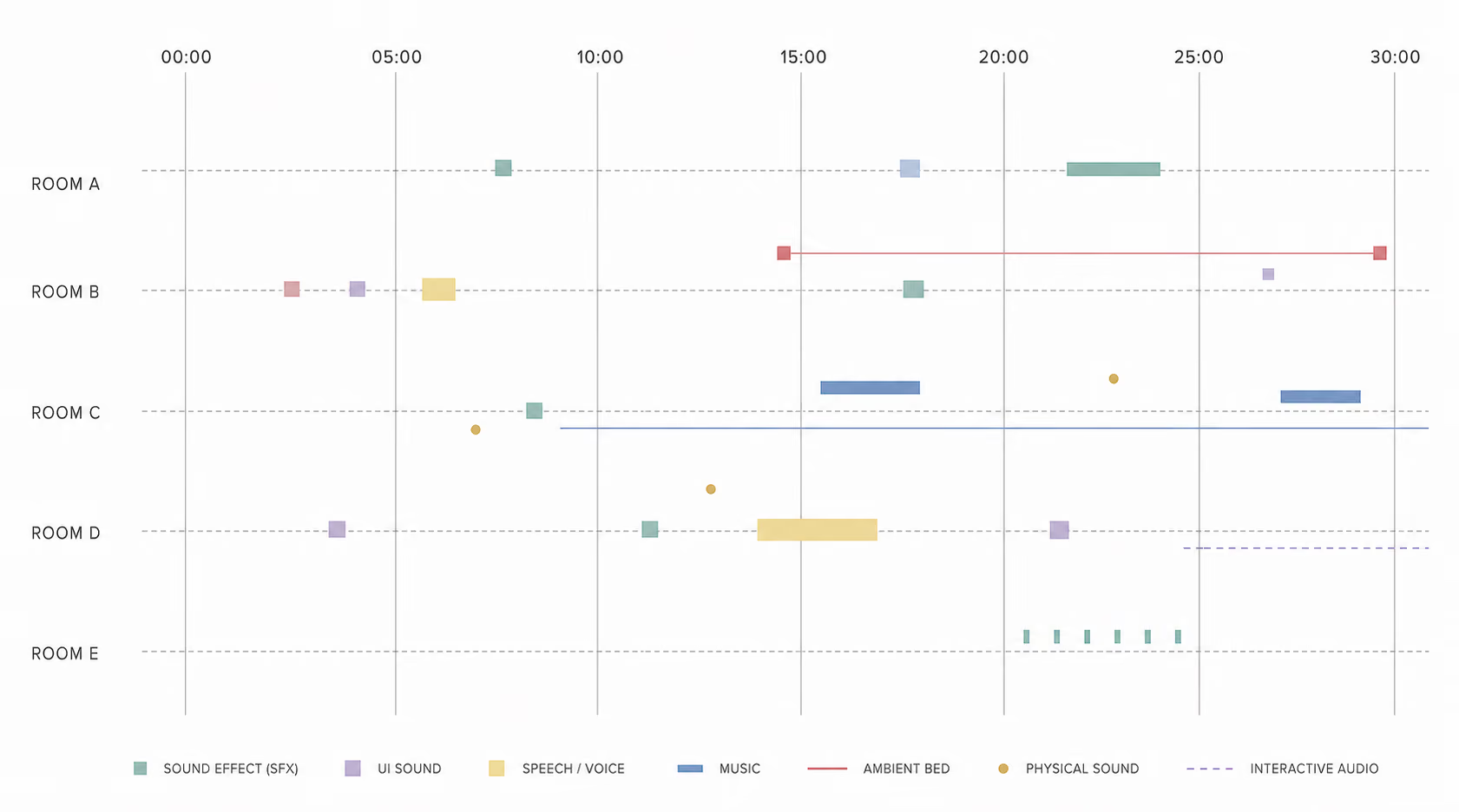
A spatial score is built as a matrix of time and space.
On the horizontal axis is the content timeline: the temporal development of sonic and media material. On the vertical axis is the spatial structure: the rooms, zones, exhibits, floors, buildings or sonic layers of the experience. Into this matrix, all sonic content is placed — music, voices, sound effects, ambiences, media sound, interface sounds, physical sound sources, triggered events, generative systems, transitions and silence.
The matrix makes the linear development of each space visible. It also shows what happens simultaneously across the whole architecture. This is the crucial shift: the spatial score defines what happens in each room and how all rooms behave together.
Content timeline
The content timeline describes when sonic and media elements appear, how long they remain, how they change, what they overlap with and when they disappear. Because sound is time-based, every sonic element needs a temporal logic: composed, looped, triggered, interactive, generative or ambient.
Spatial structure
The spatial structure defines where those elements belong. It describes how sounds relate to rooms, exhibits, screens, objects, loudspeakers, thresholds, acoustic zones and visitor positions. It also defines what can be heard from where: directly, distantly, through a wall, across a threshold or as a trace from another room.
Visitor path
The visitor path describes how people enter and move through the spatial score. Some projects work with fixed entry windows and controlled sequences. Others allow free entry, different durations and individual movement. Many spatial experiences combine recurring moments, local loops, timed sequences, interactive triggers and generative layers.
Simultaneity
The matrix shows which sonic events happen at the same time across different spaces. It reveals where sounds overlap, where they answer each other, where acoustic spill becomes meaningful and where separation is needed for clarity.
Dramaturgical coherence
The spatial score connects these layers into one larger structure. A project can have a precise spatial-temporal content system while remaining open as a visitor experience. Each visitor may enter from a different moment, route or distance, yet the experience still belongs to one coherent dramaturgy.
Sound travels beyond the visible frame. It passes through thresholds, bends around corners, filters through walls, reflects from surfaces and reaches the body before the source is seen.
Vision usually begins when we arrive. Sound can begin before we are there.
This gives the spatial score a powerful dramaturgical vocabulary. A visitor can hear a sonic event from another room before reaching it. A distant machine, voice, alarm, musical motif or atmosphere can prepare an encounter, charge a transition or make an unseen space feel present. Sound can connect moments that are physically separated and create continuity between rooms that the eye experiences one after another.
Anticipation
Visitors hear something before they reach it. The sound prepares the encounter and gives the next space emotional or narrative weight before it becomes visible.
Physical presence
Sound makes distant events present in the body. Even without visual confirmation, visitors sense activity, scale, tension or proximity.
Directional perception
Sound can orient visitors toward another room, object, route or event. It guides attention through spatial perception, distance and movement.
Temporal connection
Events in different spaces can be linked through rhythm, recurrence, echo, synchronization, contrast or silence. A moment in one room can become the preparation, consequence or memory of a moment elsewhere.
Multiple perspectives
The same sonic event can have different meanings depending on where it is heard from. Close, distant, muffled, direct, reflected or partially masked sound all create different narrative positions.
Recurring moments
Because visitors may enter the experience at different moments, important sonic events can return. These recurrences allow the spatial score to remain legible while visitors move through it individually.
A spatial score arranges the possibility of hearing one moment from another.
The spatial score becomes especially powerful in large architectural spaces. When an experience extends across several rooms, floors, buildings or exhibition zones, sonic events can unfold simultaneously throughout the site. Visitors move through an unfolding situation and encounter the work from changing perspectives.
A sound may be central in one room, distant in another and present only as a trace in a third. The same event can be experienced as a direct encounter, a warning, an echo, a memory or a consequence, depending on where the visitor is standing.
This creates a form of spatial dramaturgy with exceptional strength for sound. The ear can connect places before the body has moved between them. It can understand relation through distance. It can perceive simultaneity through architecture.
For this to work, simultaneity needs composition. Separate sonic worlds need shared timing, density, frequency balance, narrative function and acoustic behaviour. The spatial score allows these relationships to be designed intentionally across the whole experience.
Exhibitions and museums ask sound to do several things at once. It may support orientation, create atmosphere, separate media zones, connect rooms, intensify objects, clarify interaction or give visitors a feeling for the scale of a subject.
A single room may contain video, speech, interface feedback, interactive stations, neighbouring media, ambient sound, physical object sounds, visitor noise and the acoustic character of the architecture itself. The spatial score gives these elements a hierarchy and a shared dramaturgical logic.
The goal is to create the right listening condition for each moment. Some sounds guide. Some locate. Some connect. Some give emotional continuity. Some remain almost invisible and support the room from underneath.
This becomes essential when a project extends beyond one room or one exhibit. The spatial score helps turn multiple installations, media formats and sound worlds into one dramaturgical arc. It allows visitors to experience the space as a coherent world.
This connects directly to Exhibition Sound Design, where clarity, acoustic zoning, visitor movement, media coexistence and long-duration public experience become central conditions of the work.
A spatial score describes the sonic experience through several connected layers.
Sonic hierarchy
Which sounds carry meaning, which sounds support atmosphere, which sounds provide feedback and which sounds remain in the background.
Spatial position
Where sound appears in relation to rooms, objects, screens, loudspeakers, architectural zones, routes and visitor bodies.
Temporal behaviour
When sound begins, how long it remains, how it loops, how it changes, how it reacts and when it disappears.
Simultaneity
Which sonic events happen at the same time across different rooms, zones or media layers.
Transitions
How visitors move from one sonic condition to the next through thresholds, fades, motifs, silence, acoustic shifts or sudden rupture.
Media relationships
How sound relates to film, interaction, light, scenography, text, objects, projection, physical movement and visitor participation.
Acoustic zoning
Which sounds belong together, which sounds need distance, where spill supports the dramaturgy and where the architecture needs sonic separation.
System behaviour
How linear, interactive, generative and data-driven layers coexist inside one experience.
Silence and distance
Where the space needs rest, focus or openness. Silence is part of the score. It gives the ear space to understand.
The spatial score is closely connected to our broader practice of Sound Scenography.
Sound scenography defines how sound shapes perception, orientation, atmosphere and dramaturgy across a spatial experience. The spatial score translates this intention into a timeline matrix: when sound appears, where it appears, how it behaves, how it connects spaces and how it supports the visitor journey.
Spatial audio, immersive sound, exhibition sound design, interactive sound, generative sound and data sonification can all become layers within this matrix. Each contributes a different behaviour: location, presence, clarity, responsiveness, evolution or informational structure. The spatial score gives these behaviours a shared temporal and spatial logic.
This is where separate sonic disciplines become one composed experience.
We develop spatial scores early in the process, together with architecture, scenography, media planning, dramaturgy and technical design. The spatial score becomes a shared working structure for understanding how sound behaves across the whole experience before individual assets are produced in detail.
Reading the space
The process begins by reading the architecture as a listening situation: rooms, routes, thresholds, materials, sightlines, neighbouring media, visitor flow and acoustic conditions. This reveals where sound can travel, where it should stay local, where it can create anticipation and where the space needs quietness, distance or focus.
Defining the spatial-temporal structure
The spatial-temporal structure defines when and where content appears across the experience: duration, rooms, zones, chapters, recurring moments, synchronized windows, loops, transitions, silences, interactive events and generative behaviours. Because sound is time-based and spatially perceived, every sonic element needs both temporal logic and spatial placement.
Scoring the matrix
The spatial score takes shape as a matrix. Time runs horizontally. Space runs vertically. Rooms, zones, exhibits, floors or sonic layers become the rows of the score; music, voices, ambiences, sound effects, media sound, interface sounds, physical sound sources, transitions and silence become the material inside it.
Composing simultaneity
Across the matrix, simultaneity becomes visible. We can see what happens throughout the architecture at the same moment, which sounds overlap, which sounds answer each other, where acoustic spill becomes meaningful and where sonic separation is needed.
Designing visitor access
Visitor access defines how people enter the timeline. Some projects work with fixed entry windows and controlled sequences. Others allow free entry, different durations and individual movement. Many spatial experiences combine recurring moments, local loops, timed sequences, interactive triggers and generative layers.
Working with acoustic spill
Acoustic spill becomes part of the dramaturgy. A distant sound may create anticipation, connect rooms or make an unseen event feel present. At the same time, the score defines where sound should remain contained to protect focus, clarity and spatial hierarchy.
Integrating systems
Composition, sound design, spatial audio, media playback, interaction, generative systems and physical sound sources are brought into one coherent structure. The spatial score gives these layers a shared temporal and spatial logic.
On-site tuning
The score is refined in the actual space: timing, levels, frequency balance, localization, transitions, acoustic spill and silence. This is where the matrix becomes a lived listening experience.
The result is a sonic experience composed as one spatial dramaturgy.
Spatial score sits at the intersection of several KLONG practices: Sound Scenography, Spatial Audio, Exhibition Sound Design, Interactive Sound, Generative Sound and Data Sonification.
The broader spatial and dramaturgical discipline behind the work. Sound scenography defines how sound behaves across space, time, movement and narrative.
The practice of distributing, localizing and moving sound through space. Spatial audio gives the spatial score its perceptual and technical foundation.
The design of sonic presence, depth and bodily perception. Immersion depends on timing, space, movement, attention and the physical relationship between sound and listener.
The application of sound scenography to museums, pavilions and cultural spaces, where clarity, zoning, media coexistence and visitor flow are central.
Sound that responds to visitors, sensors, movement, systems or live input. A spatial score defines where and when interactive behaviours belong to the whole.
Sound that evolves through rules, data or algorithmic behaviour. A spatial score gives generative systems temporal, spatial and dramaturgical limits.
The translation of data into audible form. Within a spatial score, sonification can become part of a larger narrative, architectural or experiential structure.
These KLONG projects show different uses of spatial scoring: synchronized narrative, acoustic clarity in open exhibitions, synchronized musical architecture, pavilion-wide motif systems and kinetic audiovisual dramaturgy.
MINESET is the clearest example of a spatial score as narrative simultaneity. The former coal mine of Beringen becomes the site of an 18-minute incident unfolding across several buildings and rooms at the same time. The spatial score defines where each part of the incident appears, how it travels through the architecture and how visitors encounter it from different positions.
A sound may be direct in one room, distant in another and present only as a trace somewhere else. Visitors may hear machinery, voices or alarms before reaching their source, enter a scene while it is already unfolding, or understand the relation between buildings through sound alone. The incident becomes a spatial dramaturgy: one timeline distributed across architecture.
At House of History Bonn (Haus der Geschichte Bonn), the spatial score works as an acoustic framework for a dense and open exhibition environment. More than sixty media exhibits, including numerous interactives, create a high concentration of parallel sonic sources. Here, the task is clarity.
The spatial score defines how interface sounds, feedback sounds, media audio, modular musical tracks, room tones and acoustic zones coexist across the exhibition. It gives the sonic world a shared language, supports accessibility and visitor focus, and helps prevent the open architecture from becoming an undifferentiated field of competing sounds.
Luxembourg Pavilion at Expo 2020 Dubai
The Luxembourg Pavilion at Expo 2020 is a spatial score in the form of synchronized musical architecture. Six large orchestral compositions unfold across the pavilion at the same time. They share the same key and temporal dramaturgy, while each composition has its own theme, character and spatial identity.
This creates a highly precise musical relationship between the different floors and zones. Visitors move through distinct musical worlds that remain harmonically and dramaturgically connected. The spatial score here is close to an expanded orchestral composition: one temporal structure distributed across architecture, with several musical perspectives sounding in parallel.
Luxembourg Pavilion at Expo 2025 Osaka // German Pavilion Expo 2025 Osaka
Pavilion projects often use the spatial score to create continuity across many different exhibits, media formats and spatial situations. The core method is frequently motif-based: musical or sonic ideas return in different spaces, transformed according to scale, content, interaction and atmosphere.
A motif may appear as a full musical theme in one room, as a subtle harmonic colour in another, as a rhythmic gesture in a transition or as a small interaction sound inside an exhibit. These recurrences give the pavilion a recognizable sonic identity. They help visitors feel that separate rooms, screens, interactives and immersive moments belong to one larger dramaturgy.
In these projects, the spatial score harmonises difference. It allows many formats to coexist while giving the visitor a continuous sense of world, pacing and narrative direction.
Research Wall - Humboldt Forum Berlin
RESEARCH at the Humboldt Forum Berlin shows the spatial score in relation to kinetic and audiovisual systems. Scientific narratives, movement, media and spatial sound unfold as one continuously changing installation. The score defines how sonic layers relate to physical motion, visual behaviour and narrative density over time.
Here, the spatial score helps several streams of information coexist as one perceptual field. Sound participates in the timing, rhythm and readability of the whole system.
What is a spatial score?
A spatial score is a dramaturgical timeline matrix for sound in space. It defines when sonic elements appear, where they appear, how they behave over time and how they relate across rooms, media, architecture and visitor movement.
Is a spatial score the same as a musical score?
A musical score is the composition in musical form. A spatial score works at the scale of the spatial experience and organizes musical and non-musical sound across architecture, media, visitor movement and dramaturgy.
Does a spatial score always need a timeline?
Yes. Sound is time-based, so a spatial score always needs a temporal structure. Even interactive, generative or open-ended sound needs timing logic: when something can happen, how long it lasts, how it changes, what it overlaps with and how it relates to the rest of the space.
Is the visitor path always synchronized with the spatial score?
The spatial score defines where and when sonic and media content appears across the experience. Visitors may encounter this spatial-temporal structure through fixed entry windows, a guided sequence, free movement or hybrid formats. This distinction is crucial in exhibitions, museums and pavilions where people enter, pause and move at their own rhythm.
How is a spatial score different from spatial audio?
Spatial audio describes how sound is distributed, localized and perceived in space. A spatial score defines when and why spatial sound behaviours appear within the larger dramaturgy of the experience.
Can a spatial score include interactive or generative sound?
Yes. A spatial score can include fixed compositions, interactive feedback, generative systems, data-driven layers, sound effects, ambiences and physical sound sources. It defines how these different behaviours coexist inside the same spatial and temporal structure.
When is a spatial score useful?
A spatial score is useful whenever a project contains multiple rooms, exhibits, media formats, sound sources or visitor paths. It becomes especially important in museums, pavilions, installations and spatial experiences where sound creates coherence across complexity.
When should a spatial score be developed?
It should be developed early, together with architecture, scenography, media planning, visitor flow and dramaturgy. This allows sound to become part of the structure of the experience.
Planning an exhibition, museum or spatial experience?
We design spatial scores that connect sound, architecture, media and visitor movement into one coherent sonic experience.